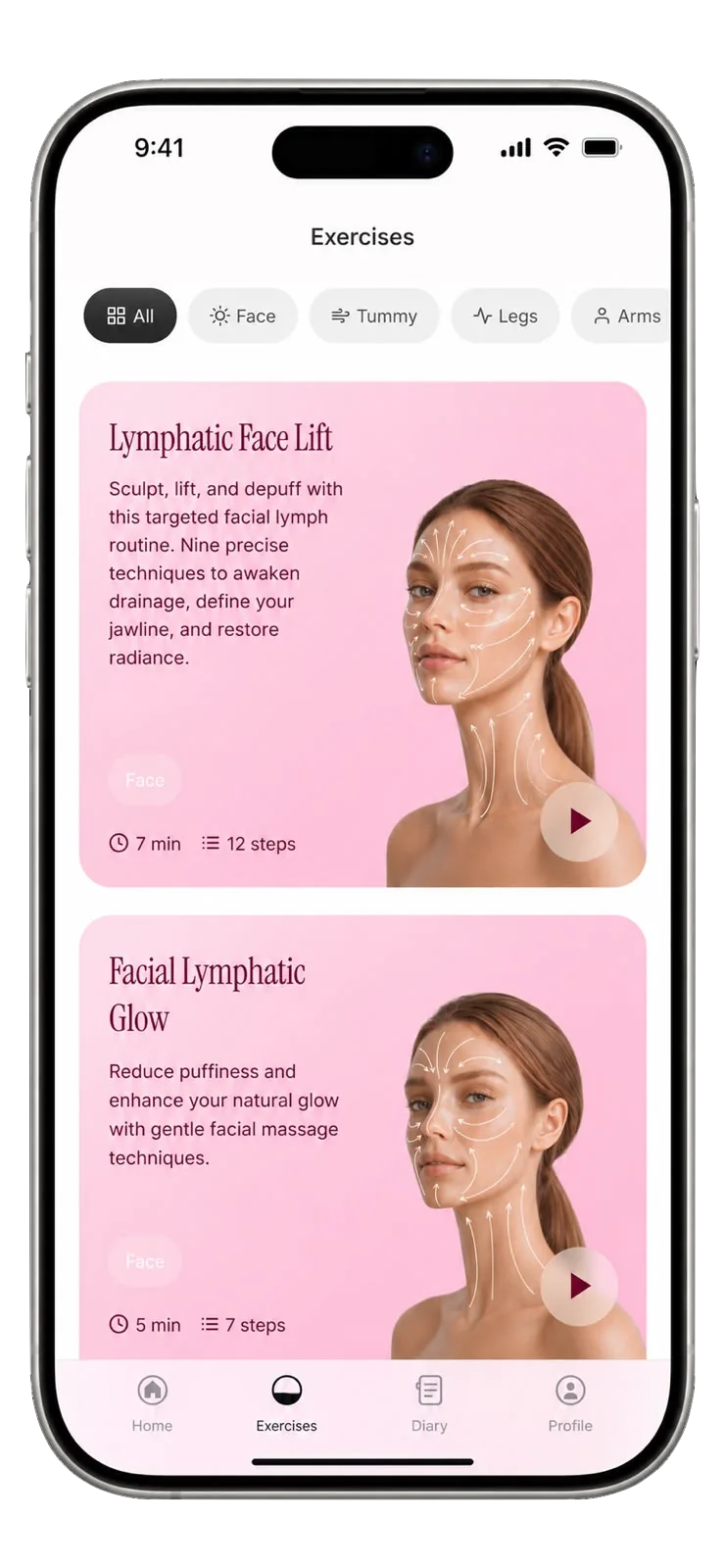
Blood has a heart pushing it around. Lymph has nothing. It moves because the vessels themselves contract gently, because muscles squeeze them as you move, and because your diaphragm creates pressure changes every time you breathe deeply. Take away movement and the whole system slows to a crawl, which is why you feel puffiest after the days you sat the longest.
That is the honest case for lymphatic drainage exercises. They are not a detox and they are not doing anything mystical. They are giving a pumpless system its pump back.
The one that does the most: deep belly breathing
If you only do one thing on this page, do this. The largest lymphatic vessel in your body runs up through your chest, and your diaphragm sits directly on top of the collecting point below it. Every deep breath squeezes and releases that area, which is the single biggest pumping action available to you.
Lie down or sit tall, hand on your belly. Breathe in through your nose for four counts so your belly rises rather than your chest. Out through your mouth for six. Ten breaths, and do it before any other drainage work so the exits are already moving.
Legs and lower body
- Ankle pumps. Sitting or lying, flex your foot up and point it down, 20 times each. Every contraction squeezes the deep calf veins and lymph vessels. This is the one to do on a plane, at a desk, or anywhere you have been still for an hour.
- Calf raises. Stand, rise onto your toes, lower slowly. Twenty reps. Your calf is often called the second heart for exactly this reason.
- Walking. Unglamorous and the most effective thing on the list. Ten minutes after a meal or at the end of a sitting-heavy day beats any single exercise here.
- Legs up the wall. Lie on your back with your legs resting up a wall for three to five minutes. Not an exercise so much as letting gravity work in the right direction for once. Best used as a finisher.
Rebounding, and whether you need the trampoline
Bouncing on a mini trampoline is the exercise the lymph world talks about most. The reasoning is sound: the repeated change between weightlessness at the top and load at the bottom compresses and releases tissue throughout the body at once, and it does it while you barely notice you are exercising.
You do not need the equipment. Gentle bouncing on the spot with your heels staying light on the floor gets you most of it, and takes 60 seconds. If you already own a rebounder, five minutes is plenty. If you do not, this is not the reason to buy one.
Arms, chest and upper back
- Shoulder rolls. Ten backward, ten forward. Opens the area around the collarbone where everything from your head and arms eventually drains.
- Arm circles. Small circles forward and back, 15 each way. Works the armpit clusters that serve your arms and chest wall.
- Cat-cow. On hands and knees, alternate arching and rounding your spine, ten slow rounds paired with your breathing. Moves the thoracic area and the abdomen at the same time.
- Neck tilts. Ear toward shoulder, hold five seconds each side, five rounds. The neck chain is the busiest node territory in the body and it stiffens from screen posture more than anything else.
A seven-minute full-body sequence
- Belly breathing, 10 breaths. Opens the main pump.
- Shoulder rolls and neck tilts, 1 minute. Clears the upper exits.
- Arm circles, 30 seconds each direction.
- Gentle bouncing on the spot, 1 minute.
- Calf raises, 20 reps.
- Cat-cow, 10 slow rounds with the breath.
- Legs up the wall, 3 minutes to finish.
Top to bottom, same principle as manual drainage: clear the upper exits before you push fluid up from the legs. Morning works if you want the puffiness off your face; evening works if heavy legs are the problem.
Exercises or massage: which should you do?
They solve different halves. Exercise moves lymph everywhere at once but you cannot aim it, so it is the background habit. Massage is precise and can target the exact area that is bothering you, but it only helps where your hands go. Puffy face in the morning is a massage problem. Generally sluggish, heavy, sat-down-all-week is an exercise problem. Most people want both, which is why the 7-day reset alternates them.
What this does not do
It does not detox you. Your liver and kidneys handle that, and they were not waiting for you to bounce. It does not treat lymphedema or any medical swelling, which needs a trained therapist and often compression rather than a home routine. If you have swelling in one limb only, swelling that arrives suddenly, or swelling with pain, redness or warmth, that is a doctor visit rather than an exercise plan.