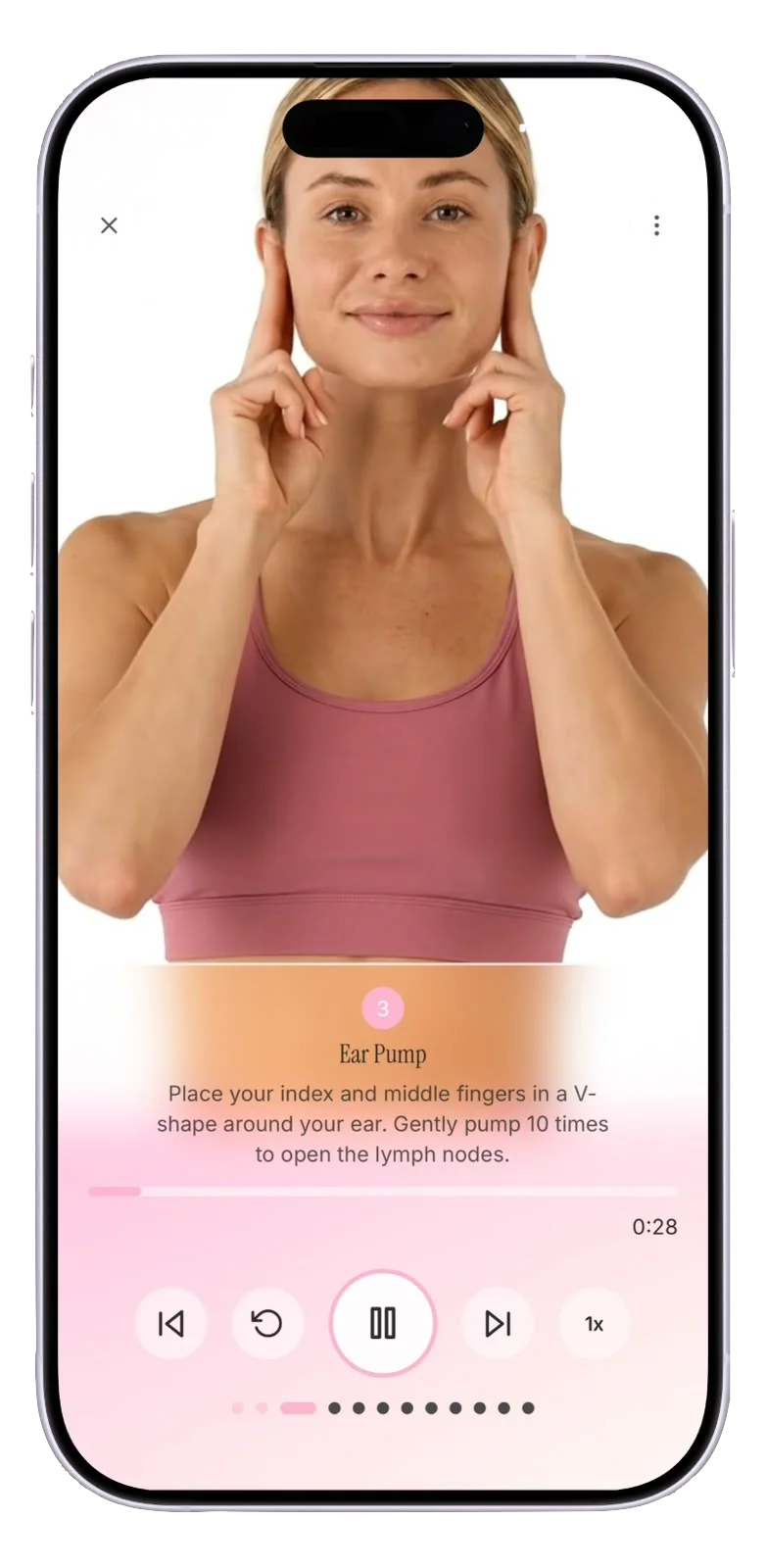
Lymphatic drainage is directional. That is the whole technique: you move fluid toward a place it can leave, and lymph nodes are those places. Get the direction right and a five-minute routine works. Get it wrong and you are giving yourself a pleasant but pointless face rub.
So the useful thing to learn first is not a stroke pattern. It is anatomy: which clusters sit where, what territory each one handles, and how to find them on your own body with your fingers.
How the system is laid out
Lymph is the fluid that leaks out of your blood vessels into your tissues all day. It has to get back into your bloodstream, and it does that by travelling through a one-way network of vessels that pass through filtering stations along the way. Those stations are the nodes. Commonly cited estimates put the total somewhere around 500 to 700 in an adult body, with a few hundred of them packed into the head and neck alone.
They are not evenly spread. They cluster at the joints and hollows: ears, jaw, neck, collarbone, armpits, groin, behind the knees. Those are the junctions your strokes should aim at, and the reason every good routine starts at a hollow rather than in the middle of a cheek.
Lymph nodes in your face and head
The nodes that serve your face sit at its perimeter. There are none in the middle of your cheek, which is exactly why the strokes there travel outward.
- In front of the ear (preauricular). Sits just ahead of the ear canal, on the soft spot you can feel when you open and close your jaw. Drains the outer cheek, temple, and the area around the eye.
- Behind the ear (posterior auricular). On the bone ridge behind your earlobe. Drains the scalp above and behind the ear.
- Under the jaw (submandibular). Run your fingers along the underside of your jawbone from chin to ear. Drains the lower cheek, the sides of the nose, lips and gums, and most of the jawline heaviness people are trying to fix.
- Under the chin (submental). The soft pocket directly under the point of your chin. Drains the chin, the middle of the lower lip, and the floor of the mouth. This is the cluster the double chin routines aim at.
- Base of the skull (occipital). Where your skull meets your neck, either side of the spine. Drains the back of the scalp.
Map that and the facial routine explains itself: from the center of the face outward to the ears, from the chin along the jaw toward the ears, then everything down the neck. For the strokes themselves, the full facial drainage routine walks through it in order.
The neck chain, and how to drain it naturally
Your neck holds the busiest node territory in the body: the cervical chain, running down each side of the neck roughly along the big diagonal muscle you can feel when you turn your head. Everything from your face and scalp passes through it on the way down. When people talk about their face feeling "congested", the neck is usually the section doing the least work.
Draining it takes about two minutes and needs no tools:
- Open the collarbone first. Rest your fingertips in the hollow just above your collarbone and press gently downward and inward, 10 slow pumps. Nothing upstream can move until this exit is clear.
- Sweep the sides of the neck. Flat fingers behind the ear, stroke down the side of the neck toward the collarbone. Light enough that you move skin rather than muscle. Ten strokes each side.
- Turn and repeat. Rotate your head to one side to expose the other, and sweep down the stretched side. This reaches the deeper part of the chain.
- Finish at the collarbone again. Ten more gentle pumps in the hollow, closing where you started.
Pressure is the thing people get wrong. Lymph vessels sit in the layer just under the skin, so the correct pressure is roughly what you would use to stroke your own eyelid. Deep kneading pushes past them entirely.
Above the collarbone: where all of it ends
The supraclavicular nodes in the hollows above your collarbones are the last stop. Lymph from your entire head, neck and arms, and from the whole left side of your body below the ribs, rejoins your bloodstream just behind them. That is why nearly every drainage routine ever written starts and ends there. Clearing the drain before you fill it is the single principle that separates a routine that works from one that does not.
The rest of the map: armpits, groin, knees, belly
- Armpits (axillary). Cup a hand into your armpit and press gently. Drains the arm, the chest wall, and the upper back. Aim arm and chest strokes here.
- Groin creases (inguinal). The fold where thigh meets hip. The main exit for both legs and the lower abdomen, and the reason leg drainage opens here before anything else.
- Behind the knees (popliteal). A small cluster in the soft hollow. The lower leg drains through it on the way to the groin, so the calf sweeps need it open first.
- Deep in the abdomen. A large collecting vessel sits deep behind the stomach, gathering lymph from everything below the ribs. You cannot reach it with your hands, which is why abdominal work relies on gentle surface strokes and deep breathing instead. Your diaphragm moving up and down is the pump that section depends on.
Clear the exit first, always
One rule ties the whole map together, and it is the one worth memorizing: work backwards from the drain. Collarbone before neck, neck before face. Groin before thigh, thigh before calf. Armpit before arm. If you start massaging a puffy cheek without opening the neck below it, you are pushing fluid into a queue that has not started moving.
Swollen nodes are a different thing entirely
Everything above is about routine fluid, the kind that makes you puffy in the morning and settles by lunch. A swollen lymph node is not that. Nodes swell when they are working through an infection, which is normal and usually resolves in a couple of weeks, and occasionally for reasons that need investigating.
Do not massage a node that is swollen or tender. See a doctor if a swollen node lasts more than two or three weeks, keeps growing, feels hard or fixed in place rather than moveable, or arrives with night sweats, unexplained weight loss or a persistent fever. The same goes for any swelling you suspect is lymphedema: that belongs with a trained therapist, not a massage guide.