Interactive lymph node map
Tap any cluster to see where it sits, what it drains, and the stroke that clears it. Free, no sign-up, works on your phone while you follow along.
Preauricular nodes
In front of the ear
- Find it
- Just ahead of the ear canal, on the soft dip you can feel appear and disappear when you open and close your jaw.
- What drains here
- The outer cheek, the temple, and the area around the eye.
- How to clear it
- Two fingers flat on the dip, gentle pumps toward the ear, 10 times. This is where your cheek strokes are heading, so open it before you sweep.
Pressure stays very light throughout, roughly what you would use on your own eyelid. Never massage a node that is swollen or tender.
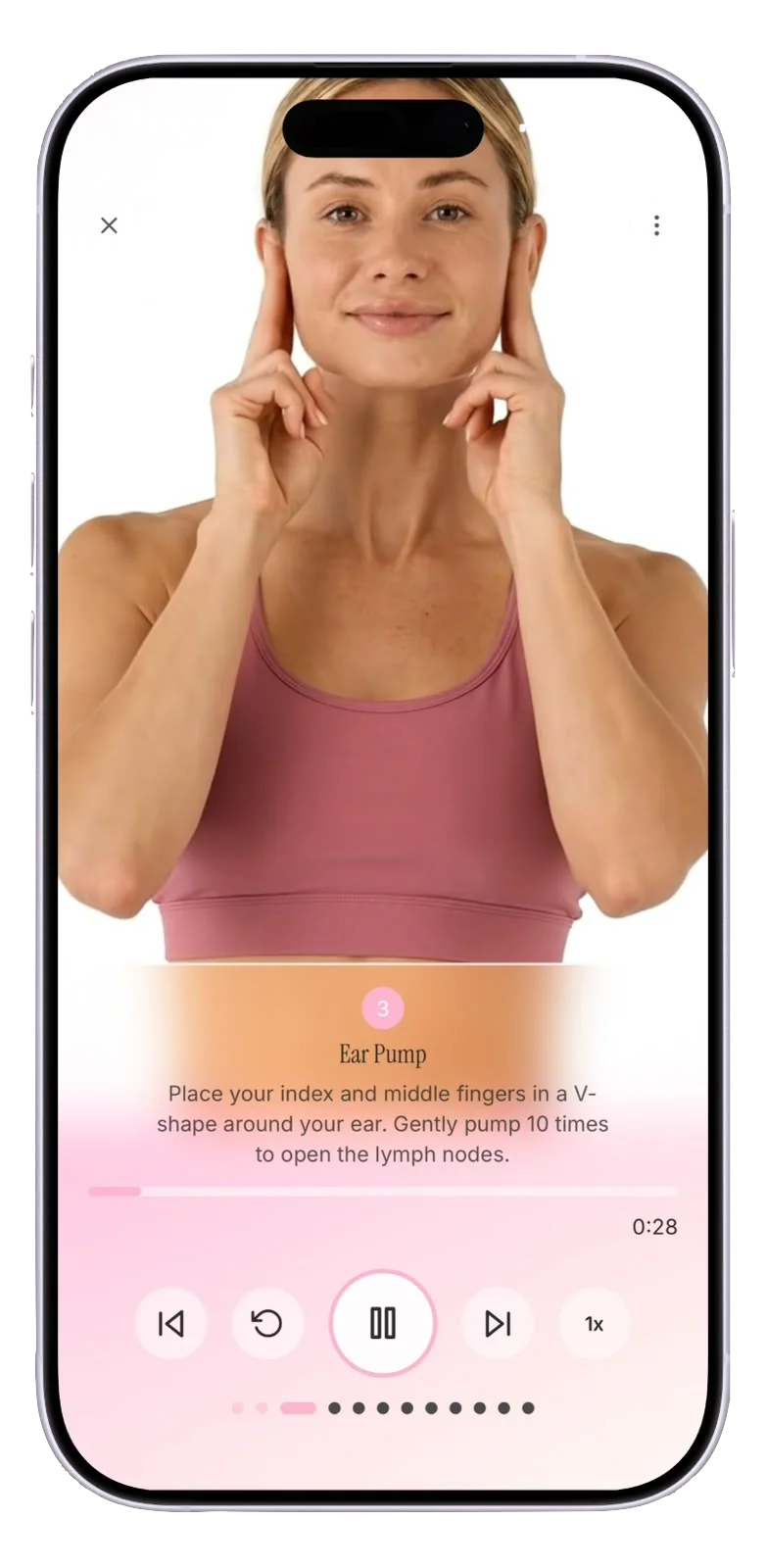
Map to muscle memory
A voice naming each one as you reach it
Finding a cluster on a diagram is easy. Finding it on your own jaw with your eyes closed takes a few goes. LymphFlow's routines are filmed video with a calm voiceover calling out each cluster and pacing every stroke, for face, tummy, legs and arms.

Free to download · iOS only
Every cluster, in text
The same reference without the diagram, for reading, printing or screen readers.
In front of the ear
Preauricular nodes
Find it. Just ahead of the ear canal, on the soft dip you can feel appear and disappear when you open and close your jaw.
Drains. The outer cheek, the temple, and the area around the eye.
Technique. Two fingers flat on the dip, gentle pumps toward the ear, 10 times. This is where your cheek strokes are heading, so open it before you sweep.
Behind the ear
Posterior auricular nodes
Find it. On the bone ridge directly behind your earlobe, where the skull starts to curve away.
Drains. The scalp above and behind the ear.
Technique. Fingertips on the ridge, small circles pressing gently downward, 10 rotations each side.
Base of the skull
Occipital nodes
Find it. Where your skull meets your neck, either side of the spine, in the hollow under the bony ridge.
Drains. The back of the scalp.
Technique. Thumbs into the hollows, press gently and hold for five seconds, release. Repeat five times. Doubles as the best two minutes of a screen-heavy day.
Under the jaw
Submandibular nodes
Find it. Run your fingers along the soft underside of your jawbone, from chin toward ear. They sit in that groove.
Drains. The lower cheek, the sides of the nose, the lips and gums. Most jawline heaviness starts here.
Technique. Hook your index fingers under the jawbone at the chin and glide back toward the ears, five slow sweeps. Light enough to move skin, not muscle.
Under the chin
Submental nodes
Find it. The soft pocket directly under the point of your chin, between the two sides of your jawbone.
Drains. The chin, the middle of the lower lip, and the floor of the mouth.
Technique. Thumb under the chin point, gentle pumps straight up into the pocket, 10 times. The cluster the double chin routines are actually aiming at.
Sides of the neck
Cervical chain
Find it. Along the big diagonal muscle you can feel stand out when you turn your head to the opposite side, running from behind the ear to the collarbone.
Drains. Everything from your face and scalp passes through on the way down. The busiest territory you have.
Technique. Flat fingers behind the ear, stroke down toward the collarbone. Ten strokes each side, then turn your head and repeat on the stretched side.
Above the collarbone
Supraclavicular nodes
Find it. The hollow you can press a fingertip into just above your collarbone, close to the base of your neck.
Drains. The final exit. Lymph from your whole head, neck and arms rejoins your bloodstream here, plus everything from the left side of your body below the ribs.
Technique. Fingertips in the hollow, press gently down and in, 10 slow pumps. Start every routine here and finish every routine here. Nothing upstream moves until this is open.
Armpits
Axillary nodes
Find it. Cup a hand into your armpit and press gently upward into the hollow.
Drains. The whole arm, the chest wall, and the upper back.
Technique. Gentle pumps into the hollow, 10 each side, then stroke the arm from wrist upward toward it.
Deep in the abdomen
Cisterna chyli and lumbar nodes
Find it. You cannot reach this one. It sits deep behind the stomach, gathering lymph from everything below your ribs.
Drains. The legs, the pelvis, and the digestive organs, all funnelling upward through your chest.
Technique. Deep belly breathing is the technique. Your diaphragm moving up and down is the pump this section depends on. Ten slow breaths, belly rising rather than chest.
Groin creases
Inguinal nodes
Find it. The fold where your thigh meets your hip, easiest to find sitting down.
Drains. Both legs and the lower abdomen. The main exit for everything below your waist.
Technique. Fingertips resting in the crease, gentle pumps 10 times each side. Every leg routine opens here before anything else.
Behind the knees
Popliteal nodes
Find it. The soft hollow behind the knee joint, easiest to reach with the leg slightly bent.
Drains. The lower leg and foot, on the way up to the groin.
Technique. Cup both hands behind the knee and press gently 10 times before you sweep the calf. Skipping it is why calf strokes sometimes do nothing.
Questions
Where are the lymph nodes in your face? +
At the edges of the face rather than the middle: in front of and behind the ears, along the underside of the jaw, and under the point of the chin. From there everything drains down the sides of the neck to the hollows above your collarbones. There are no nodes in the middle of your cheek, which is why facial strokes travel outward toward the ears.
Which cluster should I start with? +
The hollows above your collarbones, every time. That is the final exit for your whole head, neck and arms, and nothing upstream moves until it is open. Clear it first, then work backwards toward the area that is actually bothering you.
How hard should I press? +
Much lighter than feels productive. Lymph vessels sit in the layer just under the skin, so the right pressure stretches skin rather than compressing muscle, roughly what you would use on your own eyelid. Pressing harder is the most common reason a routine does nothing.
Can I use this map if my lymph nodes are swollen? +
No. Swollen or tender nodes are usually working through an infection and should be left alone. See a doctor if one lasts more than two or three weeks, keeps growing, feels hard or fixed rather than moveable, or comes with fever, night sweats or unexplained weight loss.
Is this map free to use? +
Yes, completely, with no email or sign-up. It is published by the team behind LymphFlow, an iOS app that guides the same routines on video, but the map works on its own.

Now do it with someone guiding you
Download LymphFlow and follow a filmed routine that names every cluster as you reach it.
Free to download · From $3.99/week · Cancel anytime in Settings