If your face looks puffier in the mirror at 7am than it did at midnight, that is not your imagination. While you sleep, fluid settles evenly through your tissues, and your face, being full of delicate skin with very little muscle pump underneath, holds onto it. Lymphatic drainage massage is the technique for moving that fluid along: light, directional strokes that guide it toward the lymph nodes where your body filters and recirculates it.
Spas charge good money for it. The honest secret is that the facial version is simple enough to learn in a week and needs nothing but your hands.
Where the lymph nodes in your face actually are
You cannot massage toward something you cannot find. The nodes that matter for your face sit at its edges, not in the middle:
- In front of and behind your ears (preauricular nodes). Most of your cheek and eye area drains here.
- Under your jaw and chin (submandibular and submental nodes). The jawline and lower face drain here.
- Down the sides of your neck (cervical chain). Everything from your face passes through on the way down.
- Above your collarbone (supraclavicular nodes). The final drain before fluid rejoins circulation.
That geography explains the whole technique: strokes move outward and downward, from the center of your face toward your ears, then down your neck toward your collarbone. Never the reverse. If you want each cluster located precisely, including the ones below your shoulders, the full lymph node map covers the whole body.
Does lymphatic drainage work on your face?
For temporary puffiness, yes, and you can usually see it after one session. Overnight fluid responds well to light directional massage, which is why the before and after photos people post are almost always taken in the morning. Skin tends to look a little brighter too, since the same gentle strokes stimulate blood flow.
Two honest caveats. The effect is temporary: fluid comes back, which is why this works as a short daily routine rather than a weekly event. And drainage moves fluid, not fat or bone, so it will not permanently reshape your face. What it does is remove the puffy layer sitting on top of the face you already have. Anyone promising more than that is selling something.
One more thing it is not: a treatment for lymphedema or any medical swelling. That belongs with a trained lymphedema therapist, not an app or a YouTube video.
How to do lymphatic drainage massage on your face
The golden rule first: featherlight pressure. Lymph vessels sit just under the skin, and pressing hard flattens them shut. You want the skin to move, not the muscle underneath. If it feels too gentle to be doing anything, you are doing it right.
- Open the collarbone nodes. Rest your fingertips in the hollows above your collarbones and press down gently 10 times. This clears the exit before you send fluid toward it.
- Sweep your neck. With flat hands, stroke down the sides of your neck from jaw to collarbone, 5 times each side.
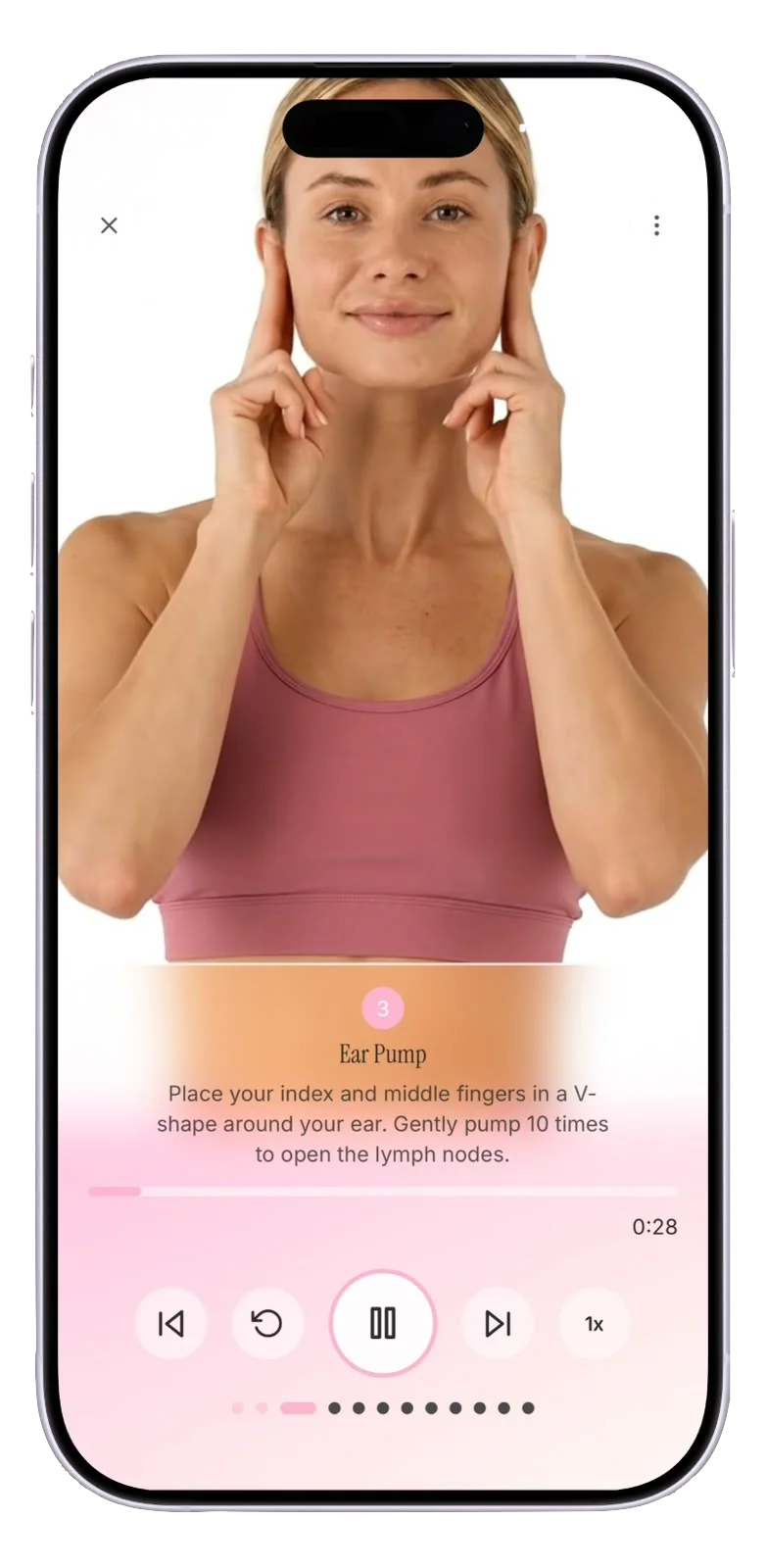
- Pump around your ears. Make a V with your index and middle fingers around each ear and gently pump 10 times. This opens the nodes your face drains into.
- Clear the jawline. With soft knuckles or fingertips, glide from the center of your chin along the jaw to your ear, 5 times each side.
- Sweep the cheeks. Flat fingers from the sides of your nose outward and slightly down toward your ears, 5 times.
- Feather the under-eyes. With your ring fingers, tap or sweep very lightly from the inner corner outward toward the temple, 5 times. This is the most delicate skin on your face; use the least pressure of all.
- Finish downward. Forehead out to the temples, temples down past the ears, then repeat the neck sweeps from step 2 to carry everything to the exit.
Total time: three to five minutes. Morning is the natural slot, since that is when the fluid is sitting there, but an evening round after a salty dinner or a long day of screens works too.
Before and after: what to expect, and when
After one session: subtly less puffiness around the eyes and jawline, usually visible within the hour. After a week of daily routines: mornings start noticeably calmer, because you keep interrupting the cycle before fluid accumulates. This is where the real before and after lives, and it is why consistency beats intensity in every version of this practice.
If you want proof rather than vibes, take a photo in the same light at the same time each morning. LymphFlow builds this in: the Body Diary stores progress photos privately on your phone and logs a daily puffy check, so the trend is visible without squinting at your camera roll.
The mistakes that make it not work
- Too much pressure. The number one error. This is not a sculpting massage; press hard and you accomplish nothing.
- Skipping the node opening. Sweeping fluid toward closed nodes is sweeping into a full sink. Steps 1 to 3 are not optional.
- Going the wrong direction. Everything moves outward and down. Upward strokes feel intuitive for "lifting" but fight the drainage.
- Doing it once and judging. One session depuffs one morning. The photographed transformations come from weeks.
Gua sha, rollers, or just hands?
Hands are enough, and they are the one tool you never leave at home. A gua sha stone or roller can make the strokes feel more ritualistic, and the light scraping motion works on the same principle, so use one if you enjoy it. Just keep the same rules: light pressure, outward and down, nodes first. The tool does not do the draining; the direction and consistency do.